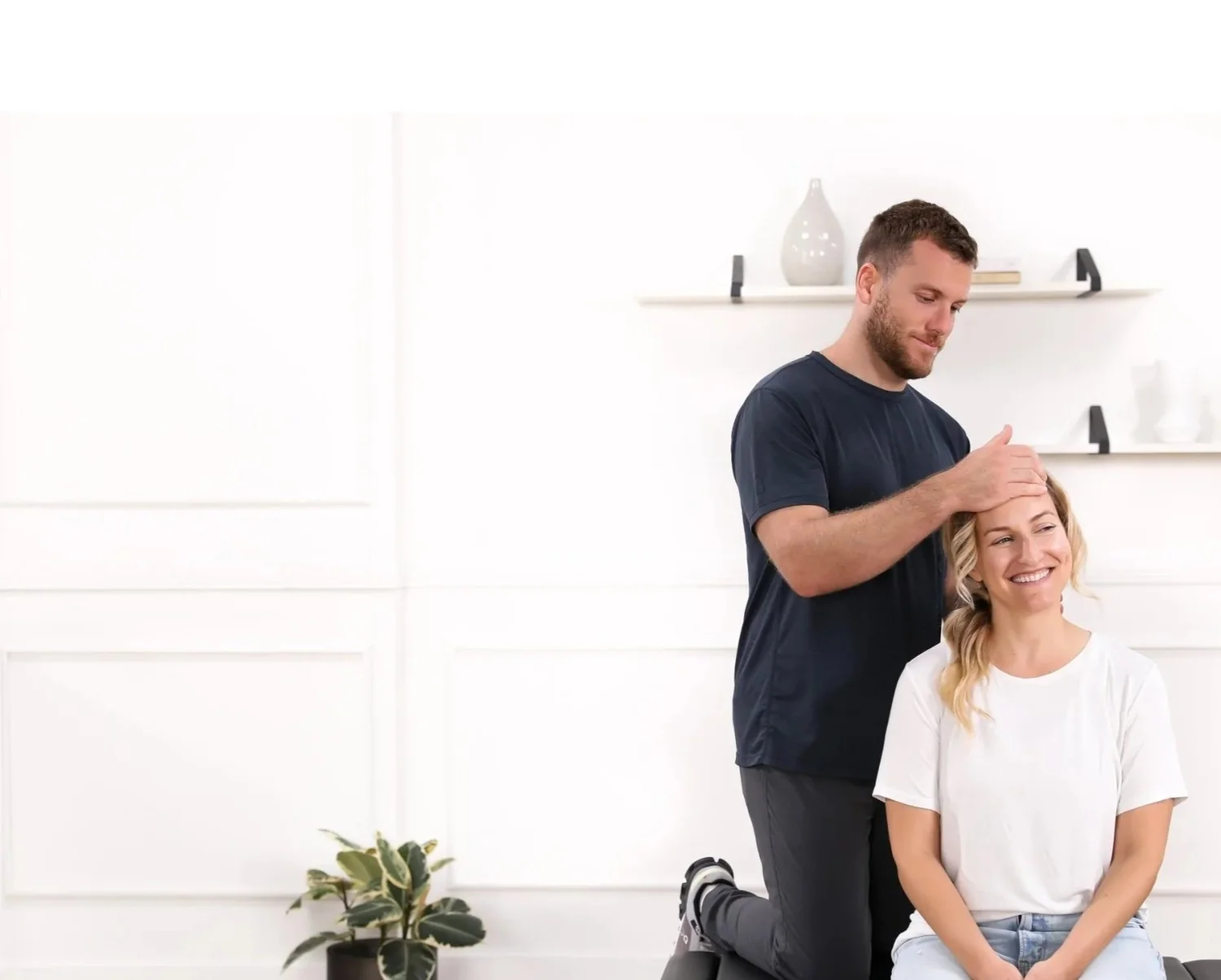
TMJ Treatment
in Clairemont
Jaw pain, clicking, and the ear or temple pain that comes with it. Care treats the jaw joint, the muscles that close it, and the upper neck. No referral needed.
5.0 214 Google reviewsOffice hours Mon & Wed 9–2, Tue & Thu 1–6, Fri 9–1
I have been a patient of Dr Stein for many years. He keeps me healthy so that I can continue doing dentistry and play ice hockey and tennis. His adjustments are precise and effective and painless. I recommend my TMJ patients to him to balance the neck and spine which affects the jaw position.
George G. Dentist, Google review
How it shows up
Jaw trouble rarely announces itself as jaw trouble. These are the four ways it tends to arrive.
A click when you open
The sound comes from the disc and the end of the jaw moving out of sequence. It is often the first sign the jaw is working under strain.
Ear pain with a clear ear
The joint sits directly in front of the ear canal, so strain there often registers as ear pain or fullness. Many people arrive after the ear has been checked.
Headache at the temple
The muscle that closes the jaw fans across the temple. A jaw working overtime often reads as a temple headache.
A tight jaw in the morning
Overnight clenching leaves the muscles tired and the joint stiff before the day has started.
Jaw pain and neck pain often show up together. When the upper neck is restricted, the jaw works from a strained base, and each keeps the other going.
What the joint actually does
Place two fingers directly in front of each ear and open your mouth. What moves under your fingers is the temporomandibular joint, one on each side, always working as a pair.
Opening happens in two parts. The first part is a hinge. Past that, the joint glides forward and down a slope of bone so the jaw can open the rest of the way.
Clicking, catching, and a jaw that swings to one side as it opens can mean the hinge and the glide have fallen out of step. That is a mechanical problem in a joint.
The joint does not work alone either. The muscles that close it anchor into the temple and the jawline, and the upper neck sets the base it moves from. There is more in our post on chiropractic care for TMJ and jaw pain.
Closed. The rounded end of the jaw sits in its socket, with the disc on top of it, in front of the ear canal.
Open. The jaw hinges, then the end of it and the disc glide forward and down the slope together.
- Socket and slope
- Disc
- Lower jaw
Why a chiropractor for a jaw
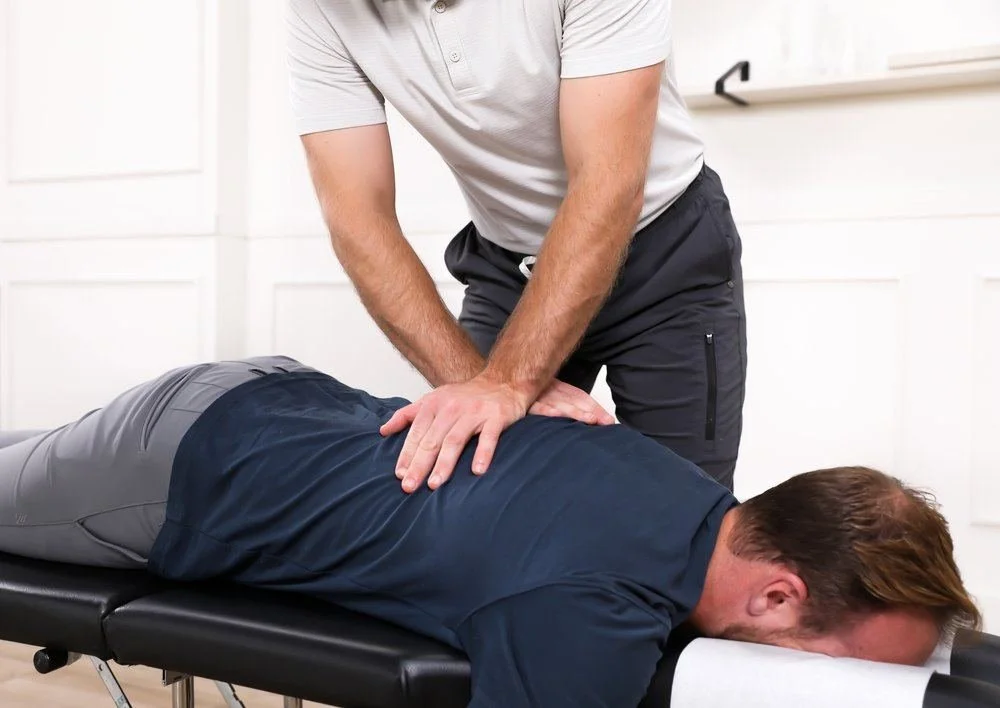
The temporomandibular joint is a joint. It has the same mechanics, the same restrictions, and the same muscle patterns as any other joint treated here. It is examined the same way.

Dr. Yossi Stein
Treats the jaw, the muscles around it, and the upper neck. The practice has been in San Diego since 1991, when Dr. Richard Stein founded it.
Care is matched to what the joint and the surrounding tissue present with on the day you come in. The chiropractor who examines you is the one who treats you, so the approach adjusts as the jaw changes.
What a first visit includes
First visits are scheduled. Call and a time is held for you, often the same day. Book online and we'll confirm your time. After that, walk in whenever we're open.
- The exam
- The jaw joint on both sides, the muscles that close it, and the upper neck.
- The explanation
- What the exam found, in plain terms, before anything is done.
- The care
- Begins at that visit when it is the right call.
- What you leave with
- What to do between visits, and what to watch for as the jaw settles.
- What you skip
- No referral, no pre-authorization, and nothing to file afterward.
About twenty minutesThe usual length of a first visit.
I came in with lower back pain and had a walk in visit with Dr. Stein. He was ready to see me very quickly and gave me immediate relief. He was awesome very helpful in explaining what I should be doing to maintain after the visit. Overall a great experience and Dr. Stein is my go to now.
Levi W. Google review
Before you come in
What does the work on the jaw involve?
Graded movement applied to the joint itself. Active Release Technique (ART) for the muscles through the cheek, the temple, and under the jawline. Precise adjustments to the upper neck where it is restricted.
The work is measured, and it goes at a pace you are comfortable with. It is the same approach used for gentle care elsewhere in the practice.
Does this replace a night guard or dental treatment?
No. We do not treat teeth and we do not fit appliances. Care addresses the joint and the muscles around it, alongside what your dentist provides.
What does a first visit cost, and do I need a referral?
No referral, and no note from your dentist. We don't bill insurance. HSA and FSA cards are accepted, and you'll know what the visit costs before any care begins.
If the exam shows this isn't something we should be treating, there's no charge for the visit. There is more on referrals and insurance if you want it.
Some situations call for hospital-level evaluation first. If you're unsure, call and we'll help you route correctly.
Dr. Yossi Stein is the best!! I drive 30 minutes to see him over other chiropractors because I trust him with adjusting my neck. I've been going to him for years and he's helped my pain so much. He has the best energy and really knows how to help people. If I could give more stars I would!
Lauren B. Google review
Chew, talk, and yawn without planning around it
If you have been chewing on one side and bracing before a yawn, you have adapted long enough. Call and we'll have a time ready, or book online.
5450 F Clairemont Mesa Blvd, San Diego, CA 92117. Office hours Monday through Friday.