
Neck Pain Treatment in Clairemont
When your neck hurts to turn, look down, or sleep on, we find where its motion is restricted. Care can start that same visit. Call for a same-day time.
5.0 214 Google reviewsOffice hours Monday to Friday
5450 F Clairemont Mesa Blvd
Complimentary parking out front
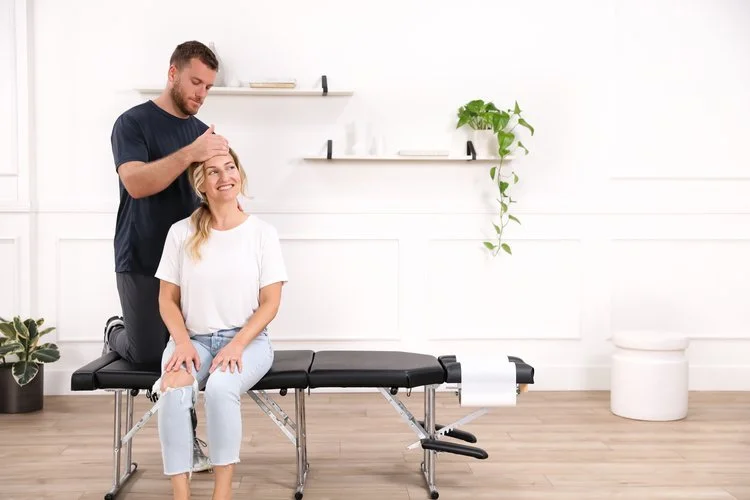
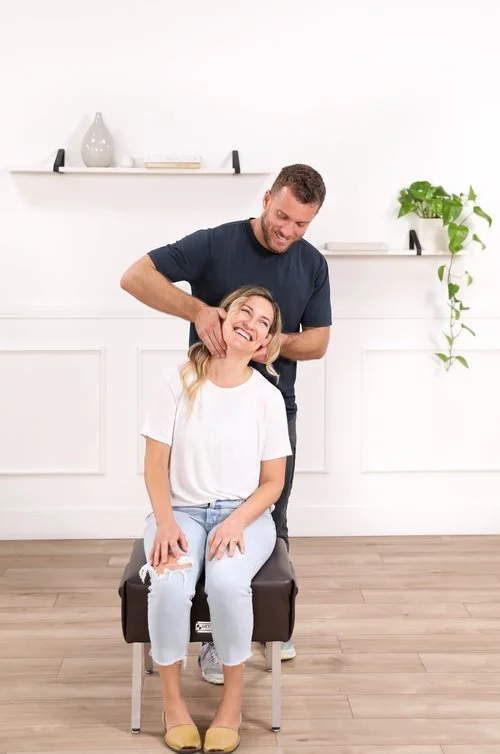
Dr. Yossi Stein is the best!! I drive 30 minutes to see him over other chiropractors because I trust him with adjusting my neck. I've been going to him for years and he's helped my pain so much. He has the best energy and really knows how to help people. If I could give more stars I would!
Lauren B.
When turning your head stops short
Most neck pain is mechanical. One or two joints in the neck become restricted, and the muscles around them tighten to guard the area.
It shows up as a turn that catches: backing out of the driveway, looking over a shoulder, finding a way to sleep.
If your neck pain began with a car accident, the exam also looks at soft tissue strained by the impact. Our whiplash page covers that care.
Where neck pain shows up
An irritated joint or nerve in the neck often makes itself felt somewhere else. The farther down the symptom travels, the lower in the neck it tends to start.
-
The base of the skull
Headaches that start at the back of the head and wrap forward. These neck-related headaches often begin in the upper joints of the neck.
-
Between the shoulder blades
An ache along the inner edge of the shoulder blade, often referred from the lower neck rather than the upper back.
-
The shoulder and upper arm
Pain over the shoulder or down the outer arm can trace to a nerve root in the neck rather than the shoulder joint.
-
The forearm and hand
Numbness or tingling in the fingers can begin with a nerve in the lower neck. Our numbness and tingling page covers it in full.
In order, from the top of the neck down.
Why neck pain comes back
Neck pain often returns. An international task force on neck pain found that many people still report it one to five years after an episode.
The usual reason is ordinary. The habit that started it is still there, and the restricted joint keeps meeting the same strain.
That is why care here aims at restored motion, not only quieter pain. The exam also asks how you spend your day.
Where we see it start
-
Screens and laptops
Hours with the head drifting toward a screen, which pulls the base of the neck forward.
-
Driving and commuting
Long stretches with the head held still, then a quick look over the shoulder to change lanes.
-
Sleep
A night on the wrong pillow, or on your stomach with the head turned to one side for hours.
-
Feeding and carrying
New parents looking down for long stretches while feeding, rocking and carrying.
-
Paddling and swimming
Surfing and freestyle swimming hold the neck extended and rotating for long sessions.
How it gets treated
What the exam finds decides what gets used, and the mix changes as your neck does.
A joint that is stuck or restricted
Chiropractic adjustments
A precise, controlled movement that restores motion to a restricted cervical joint. Most adjustments here use the Gonstead method, which targets the specific segment the exam identifies.
A joint that is inflamed or guarded
Joint mobilization
Gentle, graded movement that restores motion without asking an irritated neck to do too much at once. It suits the first days after a strain.
Muscles holding a protective pattern
Active Release Technique (ART)
A soft tissue method for the deep muscles around the cervical spine. It addresses the tightness that keeps a neck stiff after its joints move again.
Your first visit
First visits are scheduled. Call and we'll hold a time for you, often the same day. Book online and we'll confirm your time. After that, walk in whenever we're open.
-
Your history
What happened, where it hurts, and what makes it better or worse. No referral or pre-authorization is needed to get here.
-
A neck exam
Movement testing in each direction to find which cervical joints are restricted and which muscles are guarding. The chiropractor who examines you is the one who treats you.
-
A plain explanation
What the exam shows and what care would involve, before anything begins.
-
Care begins
When care is the right call, it starts that visit. You leave with a plan for the weeks ahead and nothing to file afterward.
A first visit usually takes about twenty minutes.
best most professional doctor I have ever had the privilege to see— Dr. Yossi took time to talk with me and help me create a game plan to help me rehabilitate my neck. 1,000% recommend his team
Sean D.
Before you come in
Does chiropractic help neck pain?
International clinical practice guidelines for neck pain consistently recommend manipulation and mobilization, usually alongside exercise and advice. The exam establishes whether yours is the mechanical kind those guidelines describe.
I had been struggling daily with significant neck and back pain, and he not only relieved that discomfort but also addressed the underlying issues causing it. He tailored a treatment to my specific needs rather than delivering a cookie cutter adjustment.
Andre V.
Do I need X-rays first?
Usually not. Most neck pain is assessed with a history and a movement exam, and imaging is reserved for presentations that call for it. If you already have imaging, bring it.
We've written more on whether you need X-rays to get adjusted.
What if this isn't something you should treat?
If the exam shows this isn't something we should be treating, there's no charge for the visit. Some situations call for hospital-level evaluation first. If you're unsure, call and we'll help you route correctly.
What does it cost?
We don't bill insurance. HSA and FSA cards are accepted, and you'll know what the visit costs before any care begins.

Five days a week on Clairemont Mesa
Waiting it out usually means working around it: turning your whole body to check a blind spot, sleeping on the one side that doesn't hurt.
Office hours
Mon & Wed9 AM – 2 PM
Tue & Thu1 PM – 6 PM
Fri9 AM – 1 PM
5450 F Clairemont Mesa Blvd, San Diego, CA 92117
Complimentary parking out front.